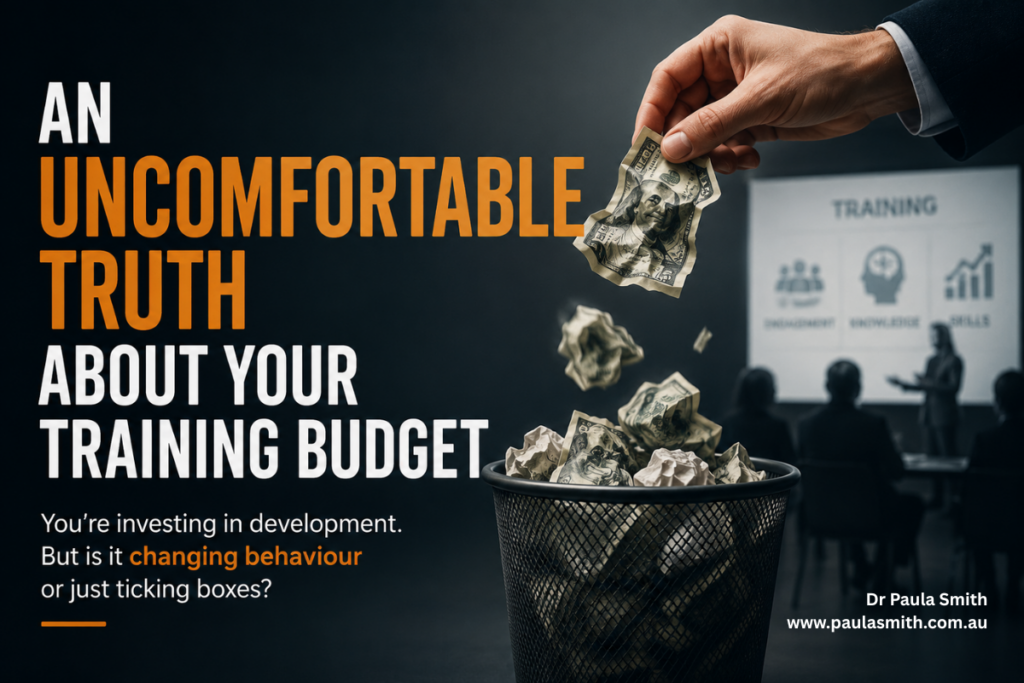
An uncomfortable truth about your training and your training budget
Every year, organisations spend thousands — sometimes millions — on training initiatives that make people feel inspired for a day… yet very little changes afterwards.
Attendance does not equal transformation and engagement during training does not guarantee implementation afterwards. Quality training and development design and delivery does. How much time and money are you wasting?
What’s going wrong?
Too much workplace training is still designed to deliver information rather than create meaningful behavioural change. Participants are often overloaded with content, expected to absorb complex ideas in a short period of time, and then return to demanding workplaces where old habits quickly take over.
The result? People leave feeling inspired, but inspiration alone rarely changes performance.
This does not mean short workshops, keynotes or masterclasses are ineffective. In fact, a powerful masterclass can create significant insight, motivation and momentum when it is strategically designed and aligned to organisational outcomes. The problem occurs when organisations expect a single learning experience — no matter how engaging — to create long-term capability without reinforcement, practice, accountability or leadership support afterwards. Or you send your staff to ‘training course 101’ with a generic trainer who trains in 27 topics only to sit through a content heavy workbook for hours and the accompanying slide pack.
Many organisations also measure success by attendance rates or participant satisfaction forms (which we call level 1 evaluation only – not totally useless, but rarely a good measure of an effective development experience) rather than asking the more important question: “What is actually changing back in the workplace?”
What do we need to change?
Effective learning transfer requires more than good content. It requires learning experiences that are practical, emotionally engaging, relevant to real workplace challenges and designed with human behaviour in mind.
People need opportunities to reflect, apply, practice and receive feedback over time. Leaders also play a critical role. If behaviours are not modelled, reinforced and embedded into workplace culture, even the best training can struggle to create lasting impact.
Staff come back from training courses brimming with ideas and no-one wants to hear them, let alone be part of implementing them. Another waste of time and money.
The organisations achieving the greatest results are not necessarily investing in more training. They are investing in better learning design, behavioural reinforcement and long-term capability development that translates into real-world performance.
Bespoke in-house training is a great way of designing training aligned to real organisational challenges and cultural values. Unless the role is more autonomous and the professional development is quite personal, then topic specific master classes delivered by an expert or private coaching could be more beneficial.
From Pedagogy to Andragogy to Heutagogy
Many organisations are still designing workplace learning using outdated teaching models too focused primarily on content delivery. Traditional pedagogy is teacher-centred, this is what you will learn…….while andragogy recognises that adults learn best when learning is relevant, practical and connected to experience.
Today, leading organisations are moving towards heutagogy — a more self-determined approach where learners take greater ownership of applying, adapting and embedding learning in real-world contexts. In a fast-changing business environment, effective capability development is no longer just about transferring knowledge. It is about developing adaptable, reflective and continuously learning professionals.
It’s now time to spend your training budget wisely
Let’s talk about getting your workforce ‘future ready’ without wasting your training dollars.
I specialise in all the people and relationship side of the business that keeps everyone thriving at work and in business. That translates to:
Leadership Development, Influential Communication, Powerful Presenting, Critical
Thinking, Human Behaviour and Collaborative Teams.