Presentation Intelligence ® – timeless speaking wisdom blended with modern science
What could a Roman orator teach us about presenting and speaking in today’s workplace? Quite a lot, actually.
Marcus Tullius Cicero was one of ancient Rome’s most influential speakers. And despite the centuries separating his world from ours, his five pillars of speaking remain remarkably relevant today. Cicero understood something about speaking that many presenters are still trying to master today and there was no PowerPoint, no microphones, no AI, not even a flip chart.
Great speaking isn’t just about confidence. And it certainly isn’t just about having those fancy slides you are probably spending way more time than you actually should creating them…just saying 😊.
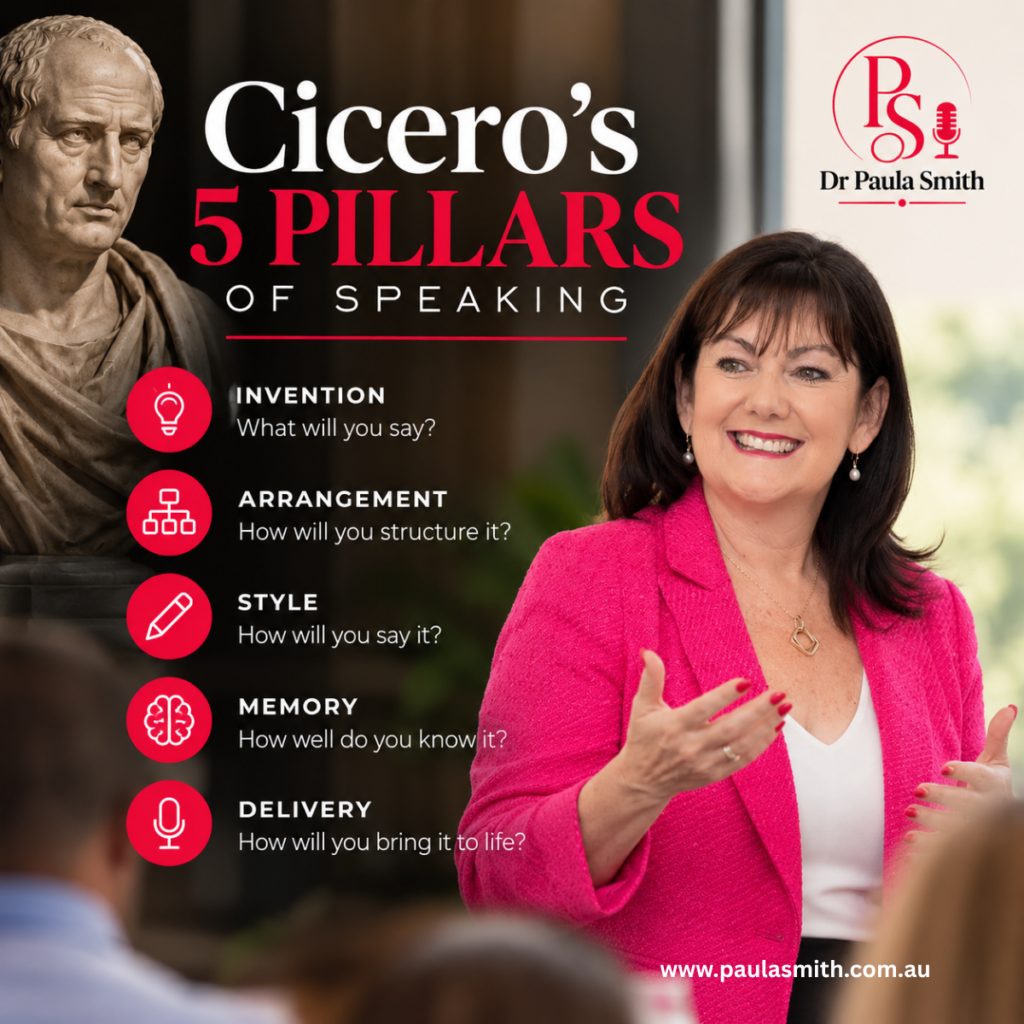
Cicero identified five pillars of effective speaking: Described as his Canons of Rhetoric.
1. Invention – What will you say? Finding the right ideas, arguments, evidence and stories for your audience.
2. Arrangement – How will you structure it? Putting those ideas into an order that makes your message easy to follow and hard to forget.
3. Style – How will you say it? Choosing language, stories, examples and rhetorical devices that bring your message to life.
4. Memory – How well do you know it? Knowing your material deeply enough that you can connect with your audience rather than simply recite content or read from a screen (especially if the tech fails – yes it happens often).
5. Delivery – How will you bring it to life? Your voice, presence, movement, energy, expression and ability to engage the people in front of you.
Cicero was onto something 2,000 years ago. What he couldn’t see though was what was happening inside the brain. Today, brain imaging, neuroscience and communication research help us understand why some speaking techniques engage us, influence us and stay with us. He was pretty close though – very impressive Cicero.
And then there was the Greek philosopher Aristotle, who understood how to influence 2,300 years ago.
He identified three essential elements of influence:
- Ethos – Credibility: Why should people believe and trust you?
- Pathos – Emotion: How do you make people feel?
- Logos – Logic: What evidence and reasoning support your message?
Three timeless principles that remain just as relevant in today’s boardrooms, workplaces and conversations as they were in ancient Greece.
Different centuries. Different audiences. Same human fundamentals.
Presentation Intelligence® (my body of work) brings the two worlds together — timeless speaking wisdom and modern science — and turns them into practical frameworks we can use in today’s workplace. And anyone can learn them.
Great speaking is art, science and practice… with a little timeless wisdom from way back
What other lessons can we take from timeless wisdom? Perhaps you can ask AI?